
- jamaica|
- community|
- January 2020
Agriculturalist, Barbara Stewart is all set to launch a one-of-a-kind compost business with members of her Beeston Spring community in Westmoreland following the successful completion of a solid waste management project implemented by the Sandals Foundation.
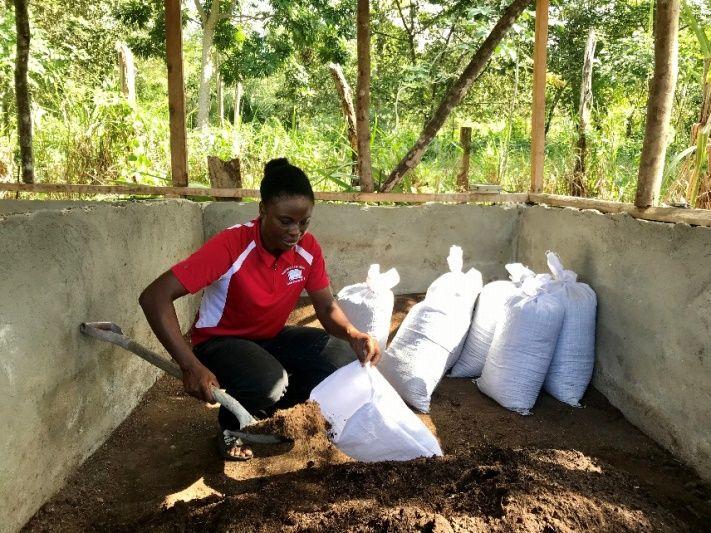
Stewart, who raises goats and chickens and grows sweet peppers and other catch-crops in a Greenhouse within the community, started collecting plant-based kitchen scraps from her community, local businesses, schools and vegetable market in November 2018 as part of the Whitehouse and Bluefields Solid Waste Reduction Project funded by the United Nations Environment Programme (UNEP).
The Project sought to educate and provide residents of the Bluefields and Whitehouse communities with a structured way of separating and better managing their solid waste. More than 200 garbage bins were provided to help residents separate their plastic bottles and compost materials from regular solid waste. A composting facility was also constructed at the Robins River Greenhouse where Barbara Stewart operates.
Bianca Young, Environmental Officer at the Sandals Foundation says to date, the programme has seen the successful collection of approximately 6000 pounds of plastic bottles and over 3000 pounds of compost material.
“We have seen a drastic improvement in the waste management habits of residents who are now making more conscious and positive choices in how much waste they generate and how they dispose of their solid waste.”
The journey for Stewart and her team continued in February 2019, when Stewart and 14 farmers from the community received training in composting by Conservation Officer at the National Environment and Planning Agency (NEPA), Barrington Taylor.
Taylor recalls the enthusiasm displayed by members of the session and noted, “The farmers were very willing and receptive to the training. I encourage all farmers to make composting a regular part of their farming so I am happy to hear that the group from Robins River is continuing their efforts. I will be on hand to assist Barbara and her team with any technical support they may need during the start-up of the business.”
Following that training, Stewart perfected the art of composting by testing the product on her seedlings and understanding the balance needed for optimal production.
The 20-year veteran farmer then began to share her compost samples with her farmer colleagues and envisioned a bourgeoning business.
The success of phase one of the waste management project in the traditionally fishing village led to the start of a second phase of the project titled, “Enhancement of the Whitehouse and Bluefields Solid Waste Reduction Project”. Through this second installment financed by UNEP and facilitated by the Gulf and Caribbean Fisheries Institute on behalf of their Global Partnership on Marine Litter (GPML-Caribe), the Sandals Foundation and Sandals South Coast Resort were all set to take the community initiative to the next level.
Now, with a goal of creating a revenue stream and ensure the activity is sustainable, the Sandals Foundation hosted a Business Management Workshop at the end of September 2019 to train community members in how to create and maintain a small business.
“The training was very informative and it was interactive,” Stewart reviewed, “It wasn’t just someone talking to us, it was us learning from each other. We learnt about profit and loss statements, how to create a brand for our product, and how to keep on top of our competitors.”
As further support, Stewart and her team are being aided with packaging, labelling and other operational costs that are essential for launching the business. Next on the agenda for Stewart is to have the product certified by the Jamaica Organic Agriculture Movement (JOAM).
“I am really looking forward to starting this business in 2020. This business will help support my farming and it will allow me to continue helping out my parents and my niece and nephew. The compost will also benefit the farmers in the community especially organic farmers who want to improve their soil fertility in a natural way and reduce costs. I think I will be able to supply compost to about 60 local farmers and hopefully more in the future.”